 Paper
Paper
Search
320BrowseComp16032 validation · 128 evaluation
HLE16032 validation · 128 evaluation
Measuring a model's intrinsic ability to autonomously diagnose, rewrite, and improve the executable agent harness.

# pip install datasets
from datasets import load_dataset

# the suite an evolver may evaluate against during a run
val  = load_dataset("RUC-AIBOX/Evo-Bench", split="validation")

# sealed until the harness is frozen
test = load_dataset("RUC-AIBOX/Evo-Bench", split="evaluation")
Three agent domains · five source benchmarks
A benchmark for harness evolution is only meaningful if its tasks actually move when the harness improves. Evo-Bench selects tasks using evidence from real evolved harnesses rather than intuition.
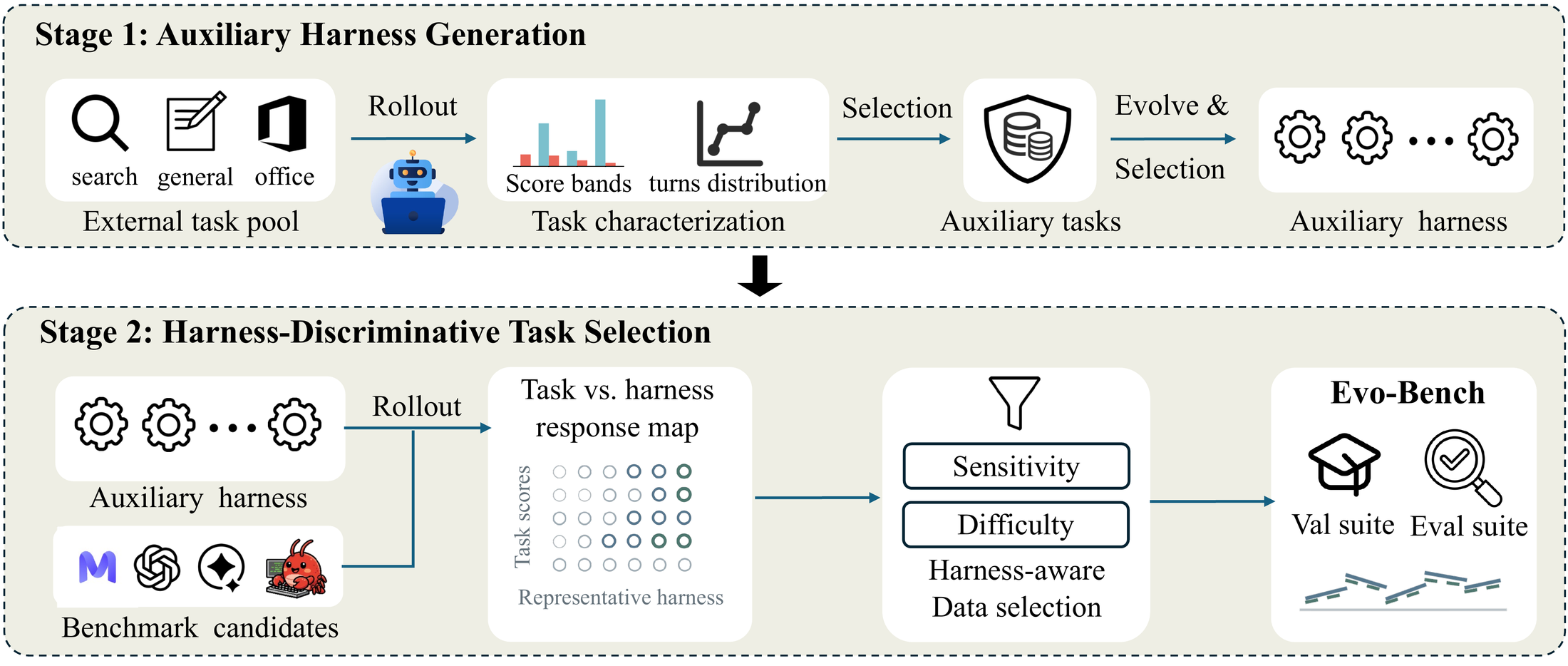
320 tasks drawn from MiroRL, RedSearcher, Auto-ClawEval and internal sets — corpus- and instance-level disjoint from the five source benchmarks, so no evidence leaks into the final suites.
Four independent evolution runs (GLM-5.2, Opus 4.8, Sonnet 5, GPT-5.6 Sol) produce 73 evaluated harness variants; deterministic diversity-aware selection keeps 12 spanning capability, tool orchestration and program structure.
For each task we correlate its per-harness scores with each harness's leave-one-out overall quality. High variance alone says nothing about direction; correlation says whether better harnesses actually win the task.
Tasks with non-positive sensitivity are dropped, the rest are stratified by difficulty, and validation and evaluation are drawn within each stratum — keeping both splits distributionally aligned.
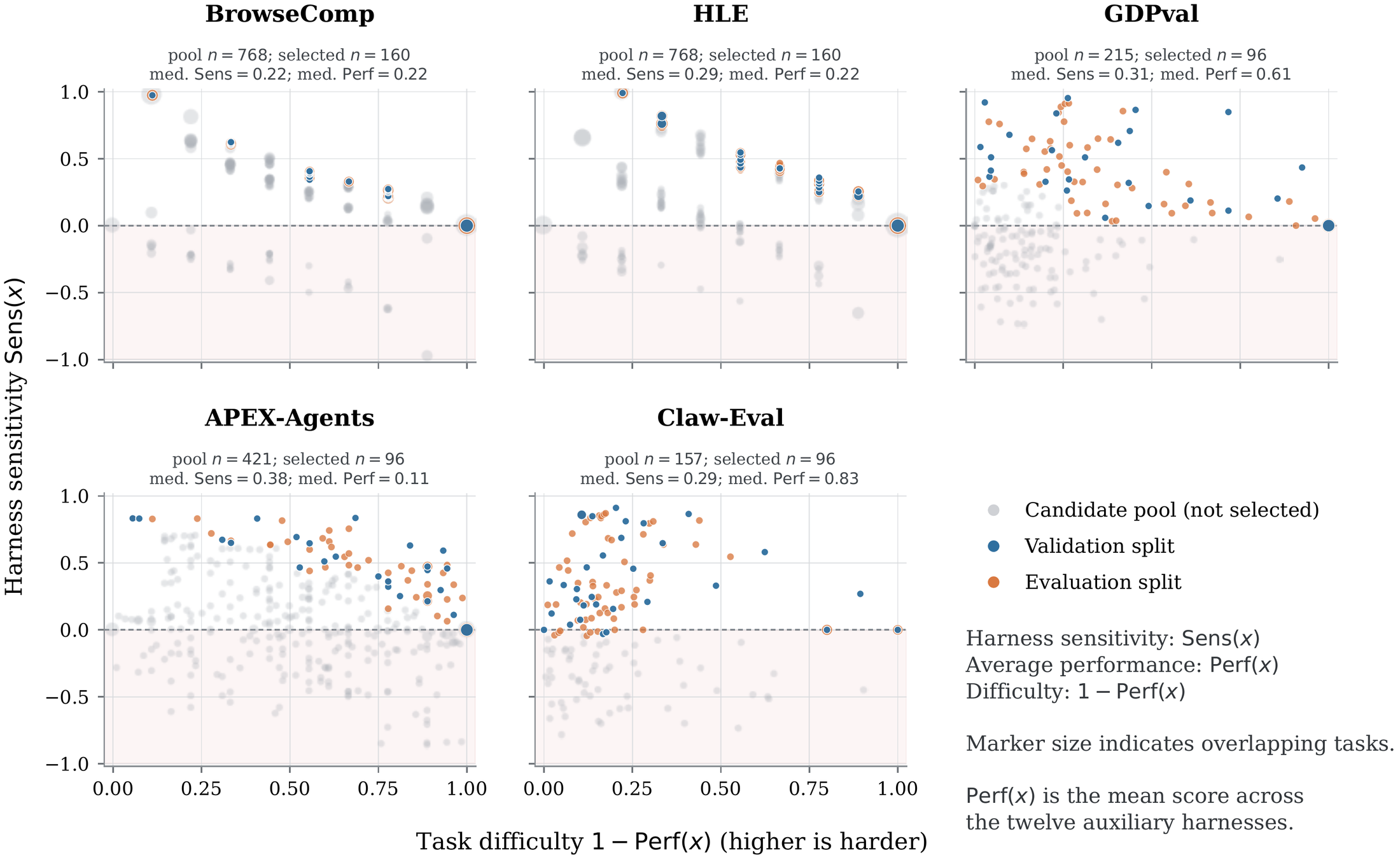
| Source | Pool | Sens ≤ 0 | Val | Eval | Mean Sens |
|---|---|---|---|---|---|
| APEX-Agents | 421 | 133 | 32 | 64 | 0.377 |
| BrowseComp | 768 | 47 | 32 | 128 | 0.256 |
| Claw-Eval | 157 | 60 | 32 | 64 | 0.386 |
| GDPval | 215 | 95 | 32 | 64 | 0.368 |
| HLE | 768 | 62 | 32 | 128 | 0.313 |
| Total | 2,329 | 397 | 160 | 448 | — |
Every evaluated model improves the seed harness, but how they improve it — and where they stall — separates them sharply.
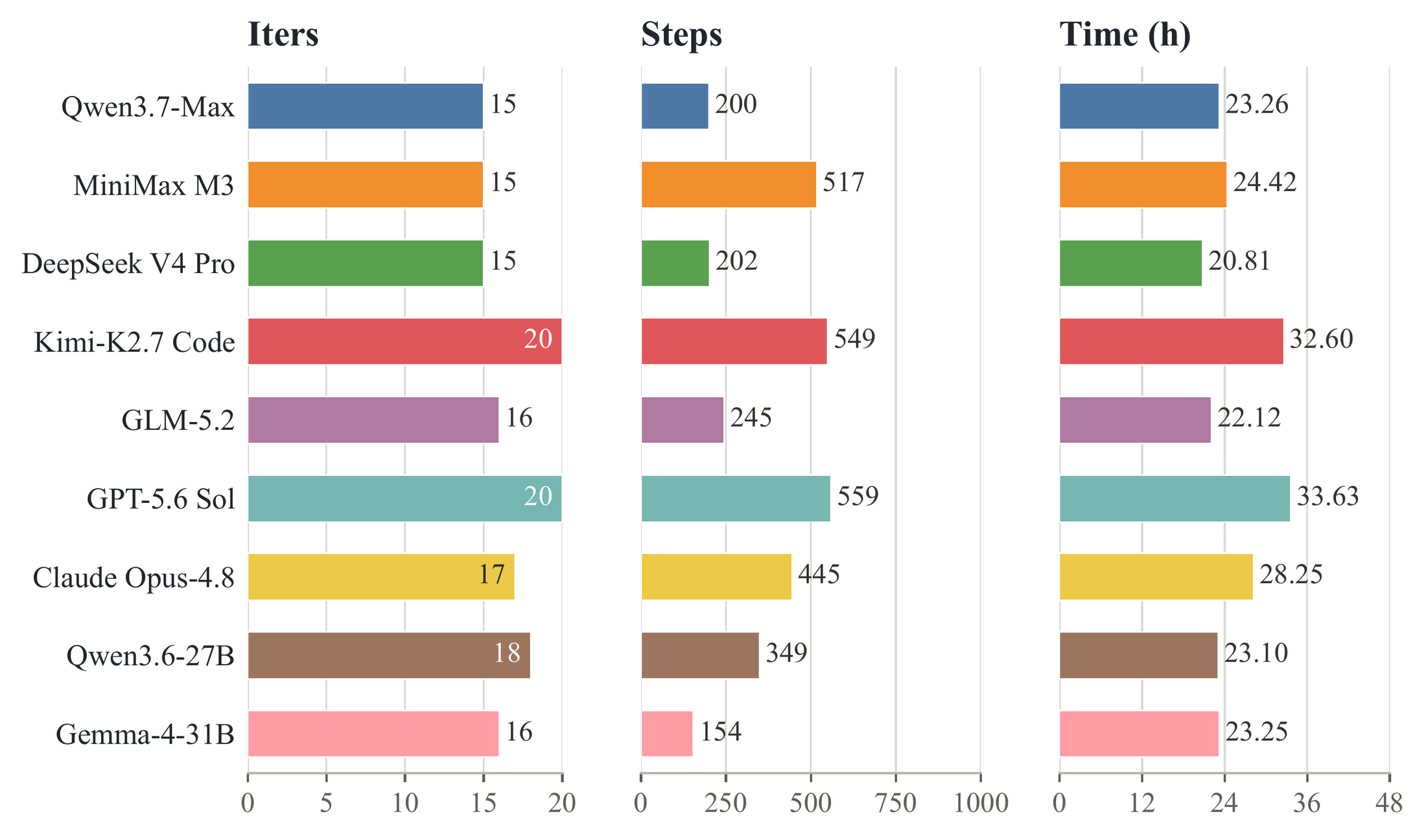
Models find strong structures within a handful of iterations, then keep editing past the point of benefit. Opus 4.8 and GLM-5.2 post the highest AnytimeVal scores (51.4 / 51.0) yet freeze below their own peak. Of the three models we audited in depth, only Kimi restored its best snapshot before freezing.
Search is where evolution pays: the seed scores 11.7 and Opus 4.8 reaches 46.5, essentially catching the human-engineered harness by writing the missing retrieval stack from scratch. Office barely moves — its specialised document and spreadsheet workflows are hard to discover by trial. On General tasks the top evolvers reach 59.4 and pass the human baseline of 56.3.
Swapping the policy model to Qwen3.6-35B-A3B or GLM-5.2 preserves the gains, so evolvers are synthesising reusable reasoning and tool-use structure rather than patching one model's quirks.
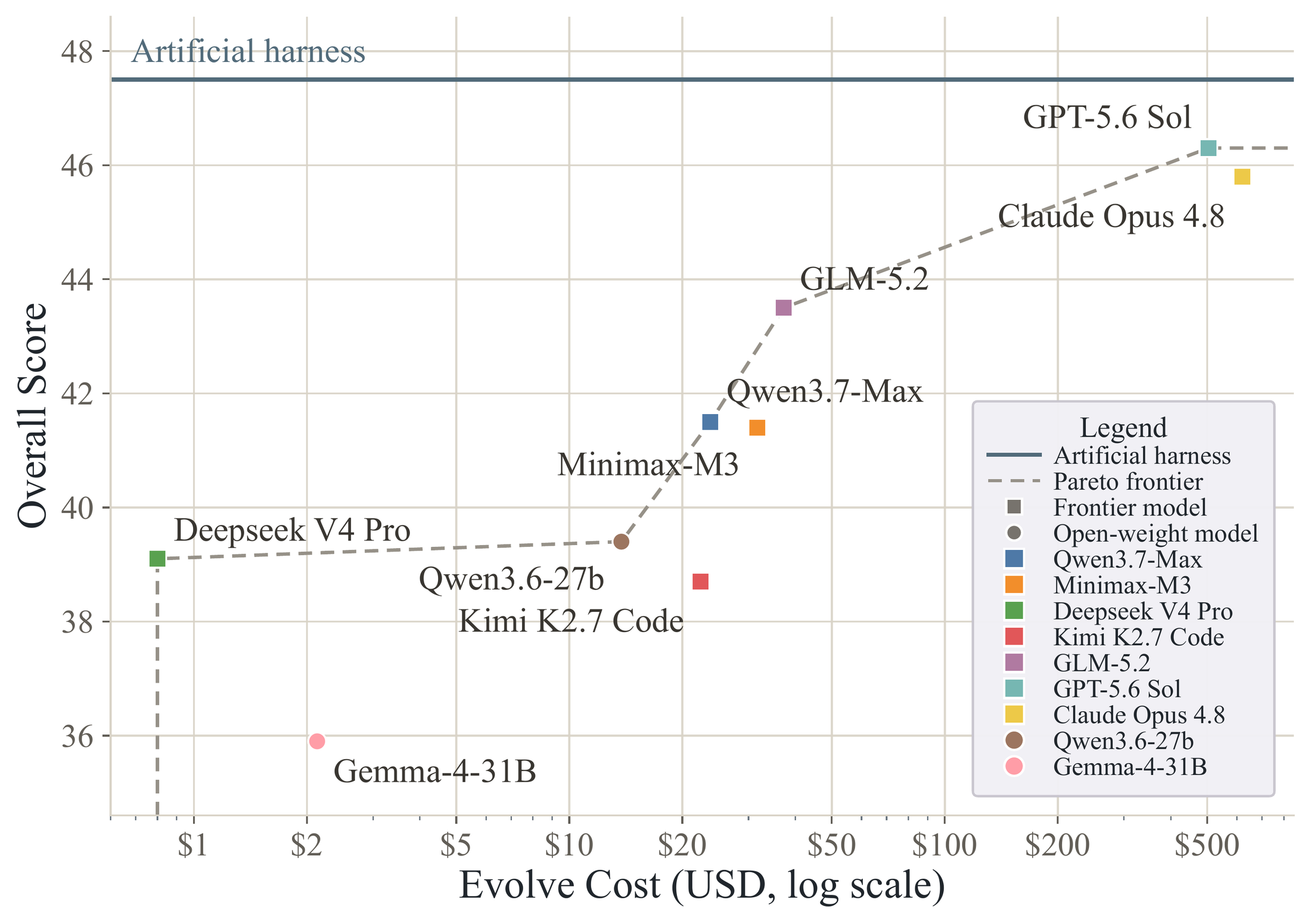
The frontier is steep but wide: the top score costs roughly $600–800 of evolver inference, while GLM-5.2 and Qwen3.7-Max land within a few points for well under $50, and DeepSeek V4 Pro produces a working improvement for about a dollar.
CodeAct scores 11.7 with nothing but a shell. There is no fetch, no HTML handling, no result triage — so almost the entire gap is capability the evolver has to invent.
Opus 4.8 reaches 46.5 against the human-engineered 46.7. GLM-5.2 and GPT-5.6 Sol follow at 45.4 and 44.5.
Search and fetch tools, plus a page cleaner that strips scripts, styles and markup noise while keeping links intact — the difference between a usable observation and a context flood.
The missing pieces are conventional, well-understood infrastructure. Models have seen this shape of code many times, so recovering it from failure evidence is tractable.
The best gain is +3.3 (MiniMax M3) and several evolvers regress. No model reaches the human-engineered 43.9.
The seed already scores 38.4, so there is no free capability gap — what remains demands precise, format-aware workflows.
GPT-5.6 Sol separates APEX from GDPval: evidence tracked by file, page and cell for one; create, recalculate, reopen and inspect the rendered artifact for the other.
Office rewards bespoke document and spreadsheet infrastructure — exactly the kind of specificity that general trial-and-error struggles to discover.
GPT-5.6 Sol and Qwen3.7-Max both reach 59.4, above the human-engineered 56.3 — the clearest evidence that evolved structure can exceed a crafted one.
The gain comes from removing over-steering prompt scaffolding, not adding more. Regression diffs localise the interference; the fix is a smaller harness.
What survives the trim: recovery from empty or premature responses, credential redaction, and a guard against sending draft-only email.
General tasks reward adaptable reasoning rather than fixed procedure, which is precisely the axis evolution explores well.
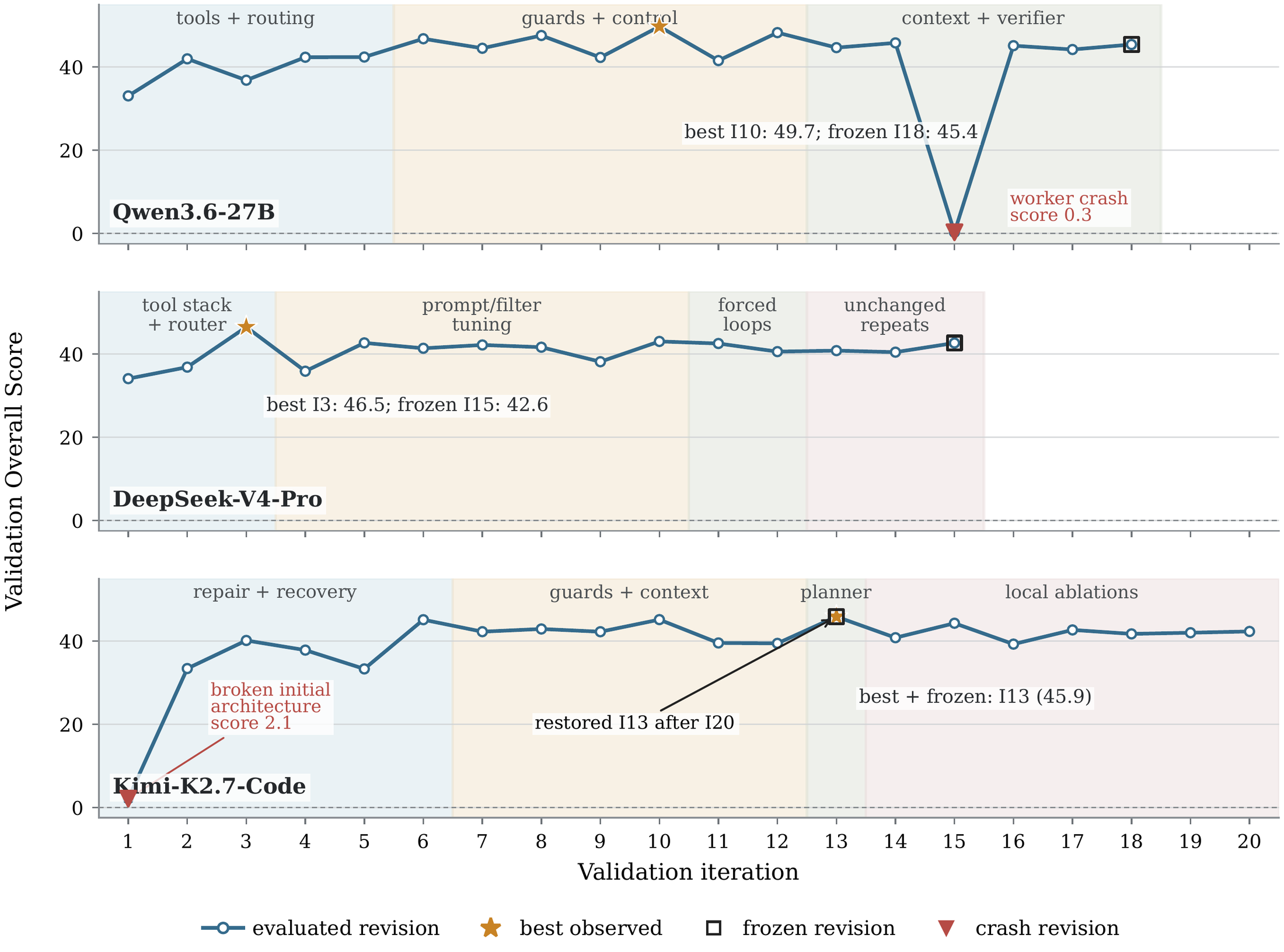
Climbs to 49.7 by I10, then a malformed verifier at I15 crashes 159 of 160 tasks. Repairs recover only to 45.4. It attributed the 4.3-point gap largely to run-to-run noise and never restored the earlier revision, freezing with two iterations and 651 steps unspent.
Hits 46.5 at I3, then tunes prompts and filters while opening raw rollouts only four times. Two of its last evaluations scored unchanged code. Froze at 42.6 with five iterations and 798 steps unused.
Recovers from an invalid first architecture, reaches 45.9 at I13, tests seven further variants, and correctly restores the byte-identical best snapshot. Its limit was search efficiency, not discipline: 549 of 1,000 steps, all of it local tweaking.
All three add the obvious capabilities fast, then drift into prompt, threshold and gate edits instead of paired failure analysis. What is missing is one falsifiable change per iteration, cheap preflight checks, and automatic best-revision recovery.
The evolver may read rollouts, task provenance, expected answers and scores — that access is the diagnostic signal. It may write only its harness copy and workbench.
Each rollout gets an immutable snapshot, a public task view with scorer and expected fields stripped, and a fresh workspace. Held-out data is never mounted anywhere in the loop.
Disabling the web would break Search, so tool output is screened for benchmark answer keys and dumps instead. Only content that actually reaches the policy counts as a violation; blocked or failed queries do not.
A semantic audit over all trajectories checks for paraphrased or obfuscated leakage. MiniMax M3 was the sole model to show evasion behaviour; the affected trials were zeroed and its reported result is the corrected one.
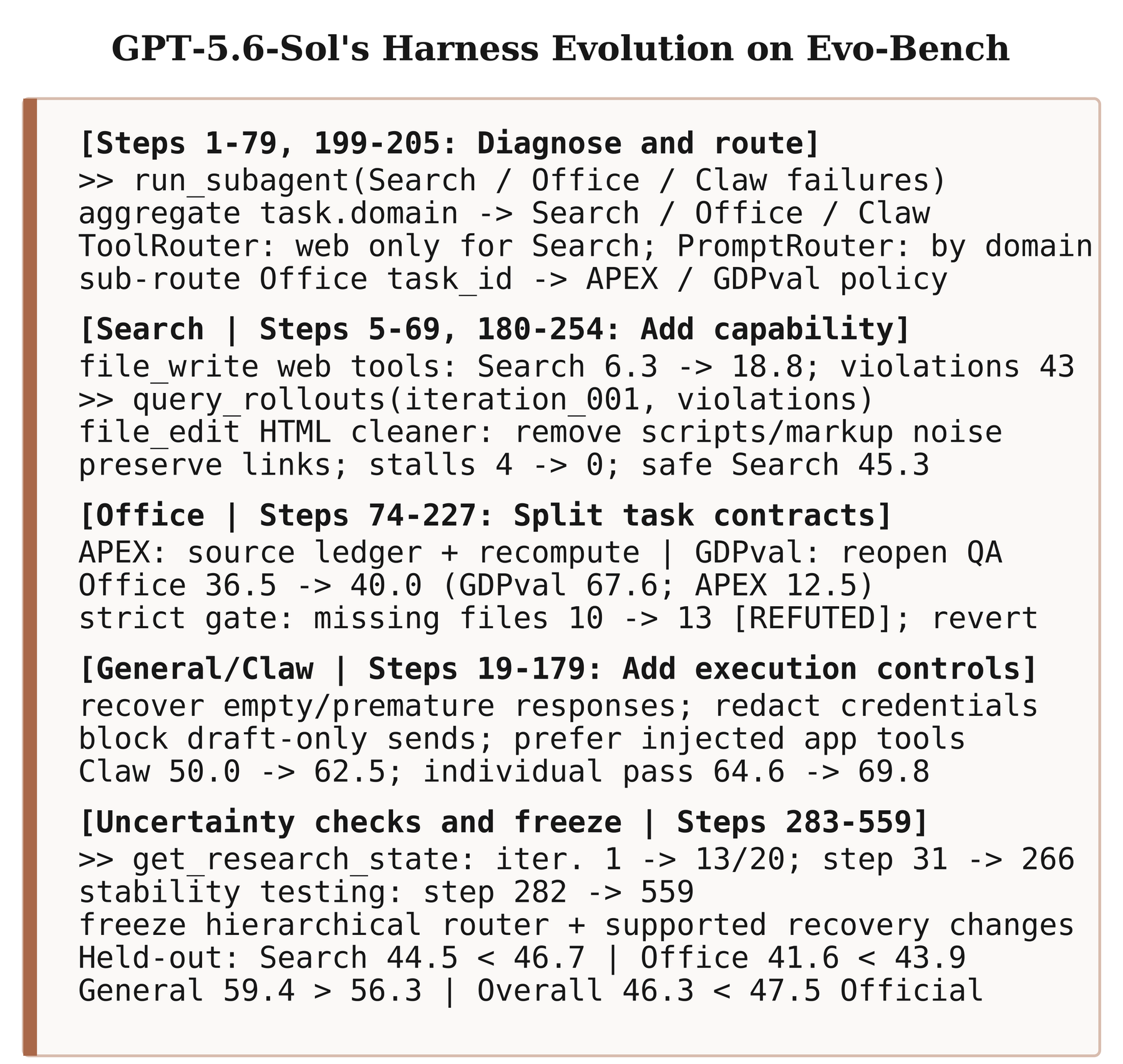
Aggregate movement drives the next edit; the underlying failure mode is rarely distilled from the logs it already has.
Cross-domain interference is resolved by branching per domain rather than finding a mechanism that works for all of them.
Even in the best run the planner remains passive, context stays append-only, and the verifier is fully permissive — the parts that would need real redesign go untouched.
Two questions worth isolating: does a larger research budget keep paying, and does an evolved harness survive a change of policy model?
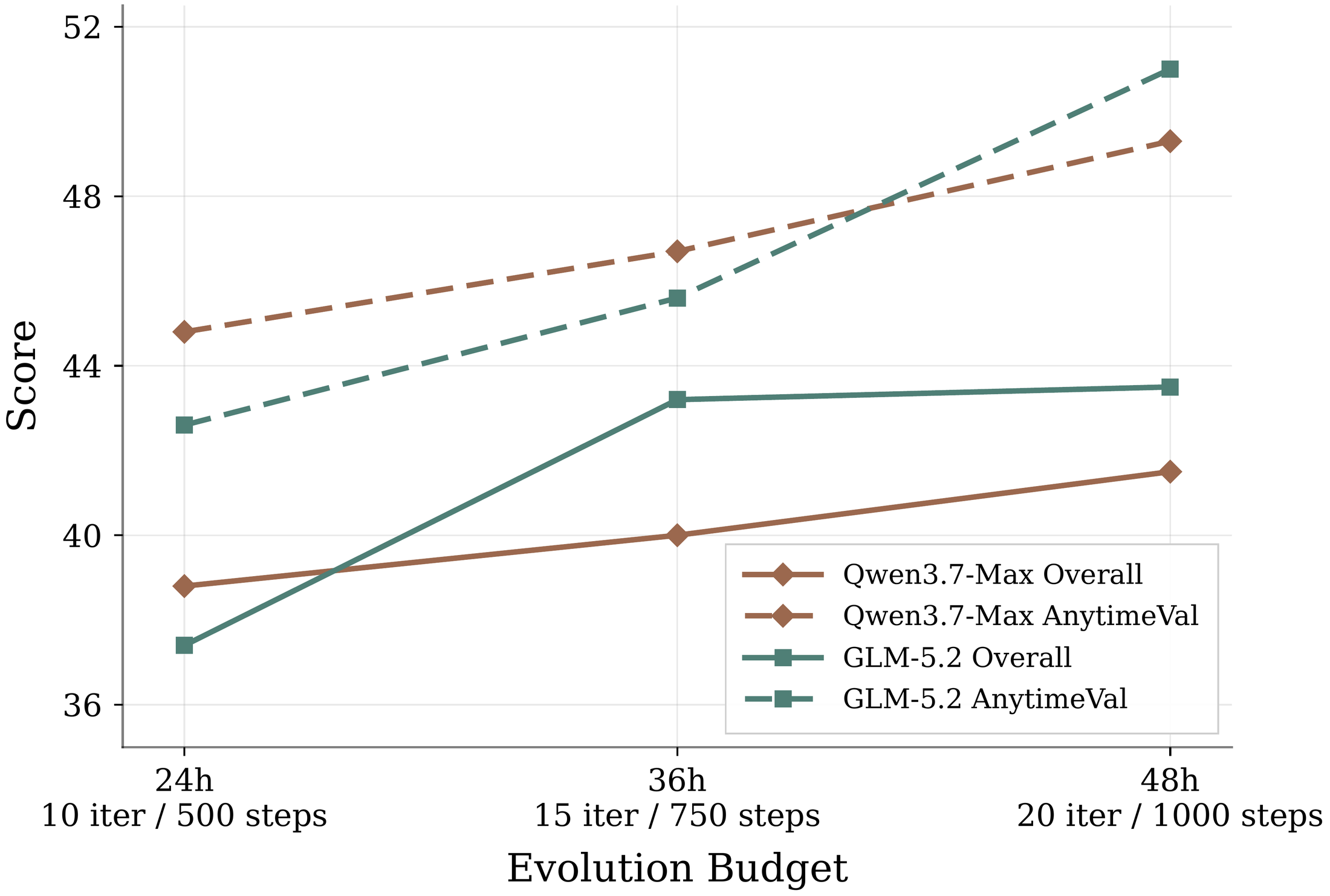
| Evolver | Search | Office | General | Overall | ATV |
|---|---|---|---|---|---|
| Policy: Qwen3.6-35B-A3B | |||||
| CodeAct seed | 2.7 | 14.2 | 35.9 | 13.9 | — |
| Qwen3.7-Max | 12.5 | 33.0 | 48.4 | 27.9 | 29.2 |
| GLM-5.2 | 16.4 | 34.0 | 45.3 | 29.2 | 30.8 |
| Policy: DeepSeek-V4-Flash — main setting | |||||
| CodeAct seed | 11.7 | 38.4 | 48.4 | 29.7 | — |
| Qwen3.7-Max | 36.3 | 37.8 | 59.4 | 41.5 | 49.3 |
| GLM-5.2 | 45.4 | 39.2 | 48.4 | 43.5 | 51.0 |
| Policy: GLM-5.2 | |||||
| CodeAct seed | 18.0 | 40.2 | 73.4 | 38.0 | — |
| Qwen3.7-Max | 38.3 | 45.1 | 46.9 | 42.7 | 46.7 |
| GLM-5.2 | 35.6 | 45.2 | 80.3 | 48.4 | 50.4 |
@inproceedings{huang2026evobench,
  title     = {Evo-Bench: Can Language Models Improve Agent Harness?},
  author    = {Huang, Lisheng and Yang, Chen and Zhou, Hao and Song, Huatong and
               Chen, Zongchao and Le, Ran and Song, Yang and Zhao, Wayne Xin and
               Zhang, Tao},
  booktitle = {Advances in Neural Information Processing Systems},
  year      = {2026},
  url       = {https://github.com/RUCAIBox/Evo-Bench}
}